
Amsterdam is a walking city through and through: nowhere else do so many sights sit this close together, and on foot you notice details you would sail straight past on a bike or a tram.
Why go on foot
The city centre is so compact that walking is often quicker and always more enjoyable than any alternative.
Everything within half an hour: from Amsterdam Central Station to the Museumplein takes about thirty minutes, straight through the loveliest part of the city.
No transport to arrange: nothing to tap in, no ticket to buy and no bike to park or lock up.
You see the details: gable stones, hoisting beams, leaning houses and hidden courtyards only reveal themselves if you take it slowly.
Stop wherever you like: a terrace, a shop, a museum or a bridge to watch the water for a moment.
It costs nothing: walking is the cheapest way to see the city, and pairs perfectly with our list of free sights.
Free walking routes
We have mapped out three routes past the finest open-air sights along the canals of Amsterdam, arranged by the century in which each area took shape.
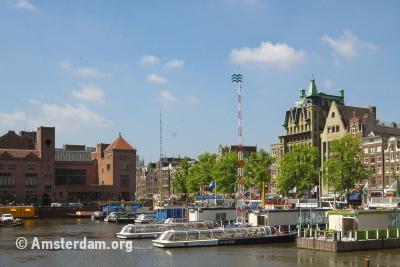
Old centre route (1275 to 1600): through the medieval heart of the city, with winding cobbled alleys and Amsterdam's oldest buildings. Allow around two hours.
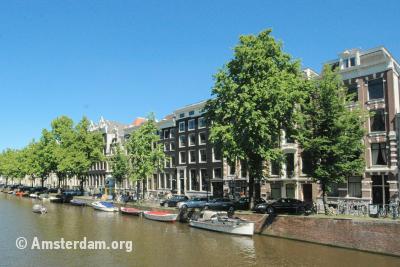
Western canal ring route (1600 to 1660): along the Herengracht, the Keizersgracht and the Prinsengracht, where the Golden Age blends with the Middle Ages. About two and a half hours.
Combine them: the three routes join up geographically, so you can also make one long day's walk of it.
The Jordaan and the Nine Streets
The city's best-known walking district, with narrow streets in which half a day disappears easily.
A working-class quarter with character: the Jordaan was built in the seventeenth century for labourers and craftsmen. Its streets are narrower and its houses plainer than in the canal ring next door.
Hidden courtyards: behind unremarkable doors lie dozens of quiet inner gardens. They are often open to all, but people live there, so keep your voice down.
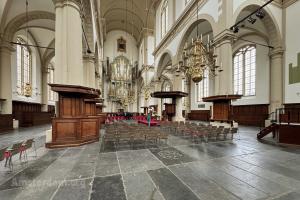
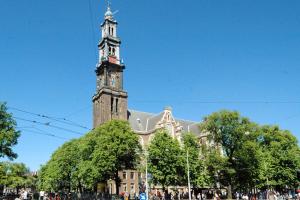
The Westerkerk: the Westerkerk on the Prinsengracht has the tallest church tower in the city and can be climbed in season.
The Nine Streets: the Nine Streets connect the canals to one another and are packed with small shops, cafés and vintage stores.
On Mondays and Saturdays: there is a market on the Noordermarkt, selling bric-a-brac and organic produce respectively. See our page on the city's markets.
The old centre
The medieval part of Amsterdam is compact and unruly, and all the more interesting to wander through for it.
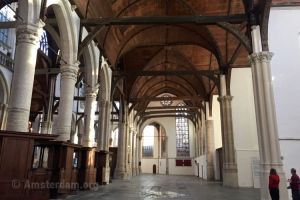
The oldest church: the Oude Kerk of 1306 stands in the middle of the city's oldest quarter, surrounded by medieval alleyways.
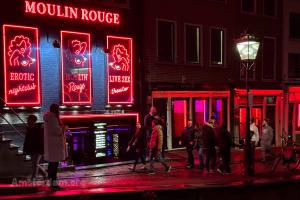
Through the Wallen: by day the Red Light District is simply a handsome old neighbourhood. Photographing the windows is forbidden, and tours along them are no longer permitted.
Chinatown and the Zeedijk: through Chinatown you reach the Nieuwmarkt, with the medieval Waag at its centre and one of the most convivial terraces in the city.
Along the wide streets: from Dam Square you can walk up the Damrak to the station, or down the Rokin towards the Muntplein.
The Jewish quarter and the Plantage
East of the centre lies an area of an entirely different character, more spaciously laid out and rich in history.
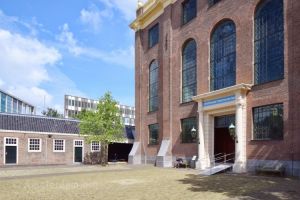
The Jewish Cultural Quarter: around Jonas Daniël Meijerplein the Portuguese Synagogue, the Jewish Museum and the National Holocaust Museum all sit within a short walk of each other.
The Plantage district: stately, leafy avenues that made for comfortable living in the nineteenth century and now house the Hortus Botanicus and the Dutch Resistance Museum.
A quieter alternative: this part of the city is noticeably less crowded than the canal ring, even in high season.
Greenery and water
If you have had enough of cobbles and crowds, all the space you could want is a quarter of an hour's walk away.
The Vondelpark: the Vondelpark runs for a kilometre and a half and is the classic Sunday morning stroll. At the far end you emerge at the Museumplein.
More parks: the Sarphatipark in De Pijp, the Oosterpark and the Westerpark are smaller and favoured mainly by locals. See our page on parks and gardens.
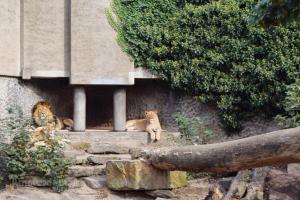
Animals along the way:Artis sits in the Plantage district, letting you break up a city walk with a turn around the zoo.
Along the IJ: behind Central Station you can follow the quaysides towards the Muziekgebouw and on into the eastern docklands.
Guided walks
A guide takes you to places and stories you would be unlikely to come across on your own.
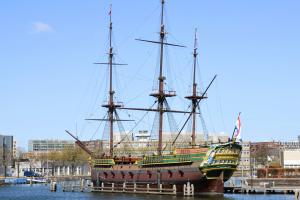
Historical city walks: on the Golden Age, the VOC, the architecture of the canal ring or the history of the city in general.
Tours of the Red Light District: tours focusing on the history of the area are permitted and give a far fuller picture than wandering round by yourself.
Themed walks: from food tours and architecture walks to routes covering the Second World War.
A free alternative: there are also free audio tours you follow on your own phone, covering Dam Square, the Rokin and the Nes.
Book in advance: in high season the most popular walks fill up quickly.
Pausing along the way
Half of a good walk consists of the stops you make along it.
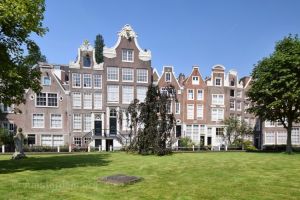
A moment of quiet: the Begijnhof by the Spui is an oasis of calm in the middle of the busiest shopping area, home to the oldest wooden house in the city.
Coffee and cake: the brown cafés along the canals are ideal for a breather. See our page on food and drink.
Toilets: public toilets are scarce. Museums, department stores, the library and larger cafés are your best bet.
Somewhere to sit: there are benches on nearly every bridge and along the canals, and on the quaysides locals simply sit on the edge.
Beyond the centre
A few minutes on a ferry or a single tram ride takes you into neighbourhoods where few tourists go.
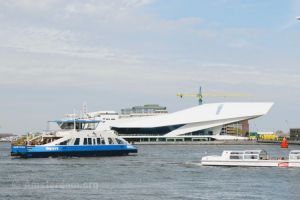
Free to the other side: the ferries behind Central Station are free. Across the water in Amsterdam Noord you can walk along the waterfront to the NDSM wharf, with its street art and old shipbuilding sheds.
Oost and the islands: from Amsterdam Oost you cross the bridges to the modern districts built on artificial islands.
Further still: the area around the city offers dunes, polders and the beach, all within an hour's journey.
Practical tips
A few things make the difference between a fine day's walking and a tiring one.
Watch out for cyclists: the red asphalt is a cycle path, not a pavement. Never stand on it to take a photograph, and always look both ways when crossing, the cycle path included.
Wear sturdy shoes: the cobbles are uneven and the bridges go up and down. You will not get far in heels.
Bring a raincoat: the weather turns quickly and an umbrella is little use in the wind. Check the weather forecast before you set out.
Avoid the busiest hours: between eleven and four the centre is at its most crowded. Early in the morning you have the canals almost to yourself, and the light is at its best.
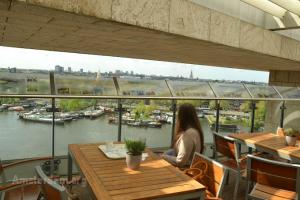
Shelter from the rain: the public library by Central Station is free to enter, has toilets and offers one of the finest views over the city from its roof terrace.
Keep your phone out of sight: pickpockets work the crowds around Central Station, the Red Light District and the nightlife squares.