The ten stops (1275 to 1600)
Every stop is a record or a first: the oldest, the widest or the narrowest in Amsterdam.
- Oudezijds Kolk 11 (1617)
One of the oldest locks in the city, with one of the oldest warehouses beside it. This was once the link between the IJ and the city canals. - Zeedijk 1 (around 1550)
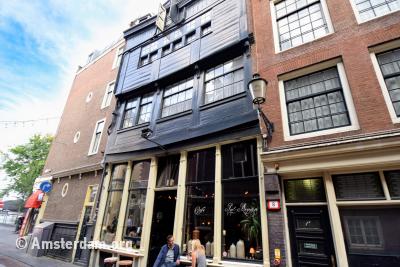
One of the last two original wooden houses in Amsterdam. After the city fires of the sixteenth century timber construction was banned, so almost none survive.
- Oudekerksplein 23 (1306)
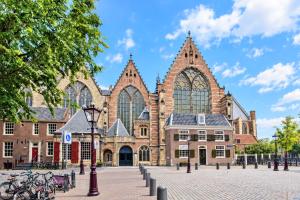
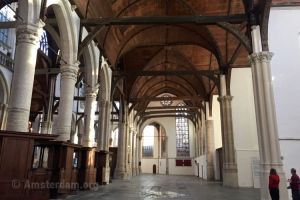
The Oude Kerk is the oldest building in Amsterdam and today doubles as a space for contemporary art. - Nieuwmarkt 4 (1488)
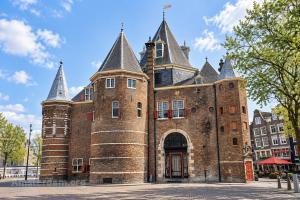
The Waag is the oldest non-religious building in the city, built as a gate in the walls. It has since served as a weigh house, guild hall, anatomical theatre and museum. Rembrandt painted his Anatomy Lesson here. - Krom Boomssloot 18-20 (1595)
Schottenburch is the oldest warehouse in Amsterdam. The gable stone reads 1636, but the building already appears on the city map of 1595. - Kloveniersburgwal 29 (1662)
The Trippenhuis is, at 22 metres, the widest private house in Amsterdam, built for the immensely wealthy Trip brothers, arms dealers. Its chimneys are shaped like cannon barrels. - Kloveniersburgwal 26
The Klein Trippenhuis is, at 2.4 metres, one of the narrowest houses in the city. Tradition has it that it was built for a Trip family coachman, who said he would be content with a house as wide as his masters' front door. - Oude Hoogstraat 22
With a façade 2.02 metres wide and six metres deep, this counts as the narrowest house in Europe. - Oudezijds Voorburgwal 249 (1610)
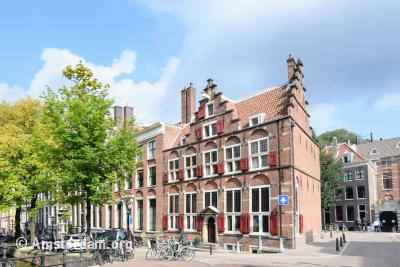
The Huis aan de Drie Grachten has three stepped gables, one facing each canal. It stands on the Oudezijds Voorburgwal of 1385, the oldest canal in the city.
- Begijnhof 34 (around 1425)
The Houten Huys in the Begijnhof is the oldest house in Amsterdam. The courtyard is free to enter, but people live there, so keep quiet.