Johan Cruyff grew up in a working-class district three hundred metres from the Ajax stadium, and set off from there to change football worldwide.
His life in this city
Almost everything that made Cruyff who he was happened within a few square kilometres of Amsterdam Oost.
Born in Betondorp: he came into the world on 25 April 1947 in a working-class district that takes its name from the concrete houses built there in the 1920s. The De Meer stadium stood across the road, where as a boy he hung about and ran errands.
His father died young: Cruyff was twelve when his father died. His mother went to work as a cleaner at Ajax, which bound him to the club more tightly still.
A debut at seventeen:in November 1964 he played his first match for the Ajax first team. With the club he won the European Cup three years running, in 1971, 1972 and 1973.
Total Football: under coach Rinus Michels, Ajax developed a style in which players continually swapped positions. Cruyff was the mind behind it on the pitch.
Barcelona and back: he left for Barcelona in 1973, where he later became coach and laid the foundations for that club's style of play. He died there on 24 March 2016, aged 68.
Betondorp and De Meer
The district where he grew up and the stadium where he played face each other in Amsterdam Oost.
The birthplace: his parents ran a greengrocer's at Akkerstraat 32, still recognisable from the two shop windows beside the front door. One of his sayings is written on the glass, with his signature beneath it. After his father died the family moved to the nearby Weidestraat.
The memorial on the Brink: the district only got a monument in December 2021, on the initiative of residents. It is a plinth bearing the number 14 and his initials, topped by a black football boot with white stripes. Nearby lies a Cruyff Court, one of the hundreds of pitches built by his foundation.
De Meer stadium: across the Middenweg stood the first ground Ajax owned, from 1934 to 1996, where Cruyff played his entire Ajax career. After demolition the Park de Meer housing estate rose in its place.
What remains of it: the old centre spot is marked in the paving, six streets are named after European stadiums where Ajax made history, and there is a Johan Cruijff bridge.
The mural: a large portrait of Cruyff by the Brazilian artist Paulo Consentino has adorned the Wembleylaan since 2017, unveiled on the day he would have turned seventy.
An ordinary neighbourhood: people live in Betondorp, so walk around quietly. It is precisely that ordinariness that shows how modest his beginnings were.
The stadiums and his legacy
His name is now on the largest stadium in the country, but his European nights were played elsewhere.
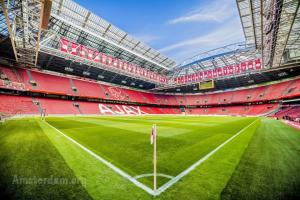
The Johan Cruijff ArenA: the stadium opened in 1996 as the Amsterdam ArenA and was renamed after him in 2018, two years after his death. On a guided tour you visit the dressing rooms, the press room and the players' tunnel, while the stadium museum covers the history of both the club and the player.
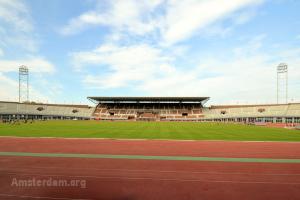
The Olympic Stadium:De Meer was too small for European fixtures, so Ajax moved them to the Olympic Stadium in Zuid, built for the 1928 Games. This is where those three consecutive European Cup campaigns were played out. The listed building is still in use and can be viewed freely from outside.
What he left behind: the Cruyff Foundation builds pitches around the world, and beside the ArenA lies De Toekomst, the youth academy where his style of play is still taught. Sayings such as "every disadvantage has its advantage" have entered the Dutch language as proverbs.
His grave is not here: Cruyff died in Barcelona in 2016 and is buried there. In Amsterdam the memorial in Betondorp and the statue at the ArenA keep his memory alive.
Johan Cruyff route through Amsterdam
Eight places that each have a demonstrable connection to his life, from his birthplace to the stadium bearing his name.
Akkerstraat 32; 1947 to 1959
The birthplace, with his parents' greengrocer's shop. A private home, so viewable only from outside.
Weidestraat; 1959 to 1968
The family's second home, where he lived until his marriage to Danny Coster.
De Brink; 2021
The memorial at the heart of Betondorp, designed by Steffen Maas.
Cruyff Court Betondorp
A pitch built by his own foundation, freely accessible and usually in use.
Wembleylaan mural; 2017
The large portrait of Cruyff in Park de Meer, the best-known image of him in the city.
Park de Meer; 1934 to 1996
The housing estate on the site of the old stadium, with the centre spot marked in the paving.
Olympic Stadium; 1928
The ground used for European home fixtures in the 1970s, now a listed monument.
Johan Cruijff ArenA; since 2018
The stadium that carries his name, with a statue at the entrance and a stadium tour.
About this route
The route begins in the district where he grew up and ends at the stadium that bears his name.
Distance and duration: around 16 kilometres. That is too far to walk; by bike it takes about an hour, excluding stops.
Take a bike: the first six stops lie close together in Oost and are easily walked, but the Olympic Stadium and the ArenA are far apart. A hire bike or public transport makes it perfectly manageable.
Or split it: stops A to F together form a compact walk of about two kilometres through Betondorp and Park de Meer, doable in a little over an hour. The last two can be saved for another day.
Start and finish: you begin in Betondorp, reachable by tram 19 or bus 41, and end at Bijlmer ArenA station, with metro and train back to the centre.
Plan the stadium tour: book the ArenA tour in advance and check there is no match or event that day, as tours are cancelled then.
On 25 April: he is commemorated at several places in the city on his birthday, with flowers laid at the memorial in Betondorp.