Nightlife in Amsterdam: from brown café to sunrise
From a beer with two fingers of foam in a brown café to a party that runs until Monday morning: in Amsterdam you decide for yourself when the night ends.
A city with several nightlives
Amsterdam's nightlife is as varied as its residents, and plays out in places that bear almost no resemblance to one another.
The big squares:Leidseplein and Rembrandtplein are the most accessible and the busiest, with bars and clubs a stone's throw apart.
The brown cafés: in the Jordaan and along the Zeedijk you drink in bars that are sometimes a century old, among locals rather than tourists.
The clubs beyond the centre: the most interesting club nights now take place in Amsterdam Noord, West and on the industrial estates, where venues set their own opening hours.
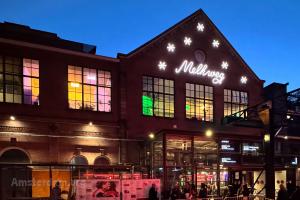
The music venues:Paradiso and Melkweg programme both concerts and club nights, often in the same weekend.
A city with a night mayor: Amsterdam has had an official night mayor for years, representing the night-time scene to the city council. That explains why the city treats nightlife as culture rather than merely as nuisance.
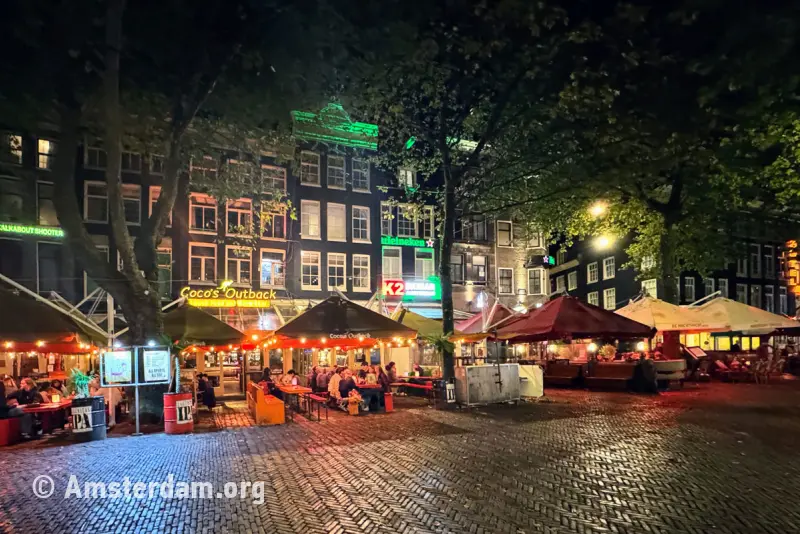
Leidseplein
The beating heart of the going-out scene, and for many visitors the natural place to start the evening.
In summer: the terraces around the square fill up late into the evening in good weather, making it a favourite place to begin the night.
Worth knowing: this is the most touristy going-out area in the city. A beer at the bar costs noticeably more here than a few streets away.
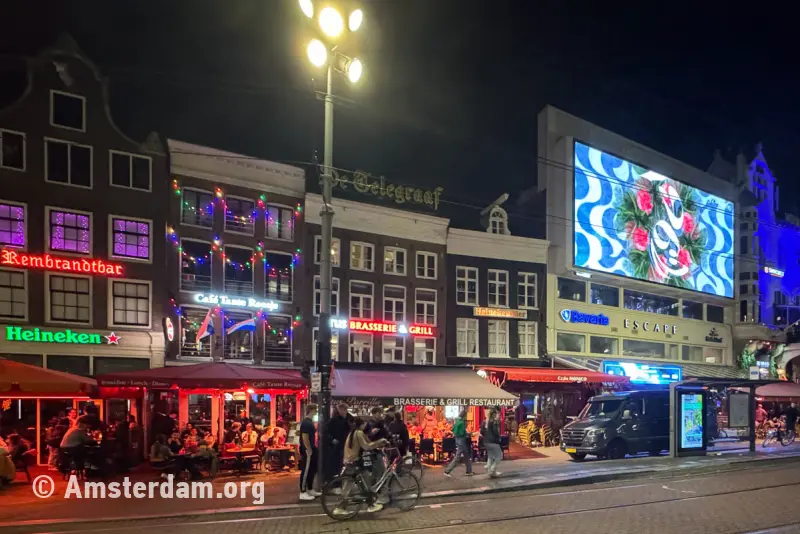
Rembrandtplein
Rowdier and louder than Leidseplein, and for many party-goers the better choice precisely because of it.
Two squares in one:Rembrandtplein adjoins Thorbeckeplein, together accounting for dozens of bars, clubs and restaurants.
A bit of everything: you will find large dance clubs and small pubs alike, and a crowd ranging from people in their twenties to a considerably older set.
The statue: in the middle of the square stands the cast-iron statue of Rembrandt from 1852, the oldest statue in Amsterdam.
Mind the bill: as on Leidseplein, prices here run higher, and a few places charge separately for service.
Brown cafés in the Jordaan
Anyone after one genuinely Amsterdam evening should head not for a club but for a brown café.
Where the name comes from: the brown walls are the legacy of decades of cigarette smoke, though some are simply painted that colour. Smoking has not been allowed there since 2008.
The interior: wooden tables sometimes still covered with a rug, curiosities on the walls and a barmaid who has been there since opening day.
What to order: a fluitje or a vaasje of beer, a jenever, and bitterballen and cubes of cheese alongside at borrel time. See our page on food and drink.
Easy to strike up a conversation: in these bars you fall into conversation with locals effortlessly, something that hardly ever happens in the clubs around the squares.
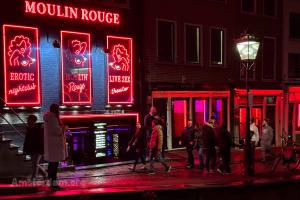
The Red Light District after dark
The city's best-known neighbourhood is also its most tightly regulated by night, and the rules have grown considerably stricter in recent years.
What you find there: besides the famous windows, the Red Light District is full of small restaurants, brown cafés and coffeeshops, set in one of the loveliest old quarters of Amsterdam.
Earlier closing times: bars in the area close at 02:00 and admit no new guests after 01:00. At weekends the windows close earlier too, at 03:00.
No alcohol or cannabis in the street: a street drinking ban applies here, and since 2023 a street smoking ban as well, carrying a €100 fine. On coffeeshop terraces it is still permitted.
Photography is forbidden: never photograph the sex workers behind the windows. Tours along the windows are also banned; tours covering the area's history are allowed.
Behave yourself: ordinary people live in this neighbourhood. Shouting and public urination carry fines that quickly run into the hundreds of euros.
Clubs and club nights
The biggest names in electronic music come from the Netherlands, and you notice it in the clubs.
Dutch DJs of world renown:Tiësto, Armin van Buuren, Martin Garrix and Afrojack all played Amsterdam clubs before conquering the world.
Clubs with a 24-hour licence: around seventeen venues in the city may set their own opening hours. Parties there sometimes run from Friday evening to Monday morning. These licences are deliberately granted only outside the centre.
Where to find them: nearly all in Amsterdam Noord, West and Nieuw-West, on former industrial sites. Expect a tram, metro or ferry ride from the centre.
Every genre: alongside house and techno, clubs play R&B, hip-hop, disco and rock. Big names appear at Paradiso, Melkweg and in the A'DAM Tower.
Check the line-up: which club is worth it on which night depends entirely on who is playing. Look at the calendar in advance rather than simply walking in somewhere.
Pub crawls
Join a pub crawl and meet other travellers over an evening taking in a selection of the best the city has to offer.
What you get: usually priority entry, a welcome drink at each venue and a guide who sets the route. Ideal if you are travelling alone.
Amsterdam Dance Event
Once a year the entire city turns into a festival site.
The biggest in the world: the Amsterdam Dance Event takes place every October and is the largest club festival and the foremost conference for electronic music anywhere.
Five days, hundreds of venues: from vast halls to tiny bars, spread across the whole city. Hundreds of thousands of visitors from dozens of countries come for it.
Daytime too: alongside the parties there are conferences, workshops and presentations on music and technology during the day.
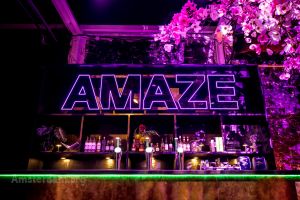
Dance all year round: if you want to know more about the Dutch dance scene, you can visit AMAZE during the day.
Opening hours and entry
Amsterdam gets going late. Turn up at a club at ten and you will often have the place to yourself.
Cafés and bars: in the centre open until 01:00 on weekdays and 03:00 at weekends. Stricter times apply in the Red Light District.
Clubs: generally open around 22:00 and close at 03:00 or 04:00. The real crowd does not arrive until around midnight.
Night cafés: a limited number of bars may stay open until 04:00 on weekdays and 05:00 at weekends.
The busiest nights: Thursday is student night, and Friday and Saturday everything is full. Sunday and Monday are considerably quieter, but that is when the smaller parties happen.
Entry: clubs usually charge between €10 and €25, depending on who is playing. For big names, buying a ticket online in advance is wise.
Card only: almost no club or bar still takes cash. Bring a contactless bank card.
Dress code and age limits
Door policies in Amsterdam are more relaxed than in many other cities, but there are unwritten rules.
Dress code: usually casual. As long as you look presentable and sober you will get into most places without trouble. Only a handful of clubs enforce a strict dress code.
Do not turn up as a large group of men: that is the single most common reason people are turned away at the door. Come in small and preferably mixed groups.
Minimum age: 18 at most clubs, 21 at some. Always bring valid ID, as it is checked.
No smoking indoors: a smoking ban applies in cafés, bars and clubs. Most places have somewhere outside where it is permitted.
On the guest list: at popular parties, reserving online in advance saves you both queuing time and money at the door.
Getting home afterwards
The most tiresome part of the night is often the journey home, and that is easily avoided.
The night bus: once trams and metros stop around 00:30, the GVB night buses take over. They run all night from Amsterdam Central Station. See our page on public transport.
By bike: the quickest way home, but cycling after drinking is an offence and lights are compulsory. See our page on cycling.
Taxis: take one only from an official rank or through an app. Never go with anyone who approaches you in the street.
Watch your belongings: pickpockets work the nightlife squares and the area around Central Station, especially at peak hours.
Buy nothing in the street: what street dealers offer is illegal, often fake and sometimes downright dangerous.
The most popular clubs:
Paradiso
Paradiso, housed in a former church, is a legendary music venue in the heart of Amsterdam. This iconic building on the Weteringschans has held a special place in the music scene since the 1960s and attracts artists from all over the world. What can you expect at Paradiso? - Unique Concerts: Paradiso is known for its ...
The Melkweg is one of the most iconic cultural venues in the Netherlands, known for its diverse offering of music, art, film, and theatre. This unique centre for pop culture attracts visitors from all over the world and provides a platform for both emerging artists and international stars. What can you expect at the ...
The Jimmy Woo is one of the most iconic nightclubs in Amsterdam, known for its exclusive atmosphere and stylish design. This club attracts both local partygoers and international celebrities and is famous for its unique blend of music, luxury, and a top-class crowd. What can you expect at Jimmy Woo? - Exclusive ...
Club Maïa is a hidden gem on the bustling Korte Leidsedwarsstraat, just around the corner from the iconic Leidseplein. Nestled among some of the city’s most popular clubs, Club Maïa offers a unique nightlife experience in a setting that feels both luxurious and cosy. What can you expect at Club Maïa? - Beautiful ...
Experience one of the most iconic nightclubs in the Netherlands, Club Escape, located at the vibrant Rembrandtplein in the heart of Amsterdam. Since 1986, Club Escape has been known for its spectacular parties, entertaining the crowd with both local and international DJs until the early hours. What can you expect at ...
The Chin Chin Club on the Rozengracht is the place where delicious food and vibrant parties come together. With its bright red walls and an abundance of Maneki Neko (lucky cats), this 'social club' offers a spectacular and unique experience from the moment you step inside. What can you expect at the Chin Chin Club? - ...
AIR Amsterdam on the Amstelstraat is the place for a unique nightlife experience in the heart of Amsterdam. This massive nightclub offers an unforgettable evening filled with cutting-edge dance music and an atmosphere of freedom and creativity. What can you expect at AIR Amsterdam? - Multiple Floors and Bars: AIR ...
In the heart of the vibrant Reguliersdwarsstraat, you’ll find Club Nyx, a club where everyone is welcome, regardless of background or sexual orientation. With an open and inclusive atmosphere, this is the place to enjoy a colourful night filled with music, entertainment, and surprises. What can you expect at Club Nyx? - ...
Thursday, Friday and Saturday are the busiest. Thursday is traditionally student night, so you will come across more locals than tourists.
What time does the night start?
Later than you may be used to. Bars fill up from around nine, but clubs only get going near midnight and stay busy until closing.
Why are some clubs 21 and over?
Clubs open to over-18s often end up with sixteen and seventeen-year-olds inside. By setting the limit at 21, venues deliberately target a young adult crowd.
What is a 24-hour licence?
A permit allowing a venue to set its own opening and closing times. Amsterdam grants around seventeen of them, exclusively outside the centre, to spread the nightlife and give cultural initiatives room to work.
Where was the iT nightclub?
The iT was opened by Manfred Langer on 7 September 1989 at Amstelstraat 24. The club closed for good in 2004. Since 2010 the site has been occupied by Club AIR.
Where was the RoXY nightclub?
The RoXY opened in August 1987 at Singel 465-467, founded by Arjen Schrama, DJ Eddy de Clercq and artist Peter Giele. On 21 June 1999, the day Peter Giele was buried, the club burned down entirely. It never reopened.






 Buy tickets in advance now

 Display on Map